Child Safeguarding Standards
Summary for parents and guardians — safety principles, children's rights, response procedures and contact details.
Legal basis: Act of 13 May 2016 on countering threats of sexual offences and protection of minors (Kamila's Law)
Journal of Laws 2026, item 110 · Version 2.0
What are Child Safeguarding Standards?
Child Safeguarding Standards are a set of rules and procedures that apply to every member of staff at Nido Family Centre. Their purpose is to keep children safe during diagnostic and therapeutic visits, and to ensure a swift response whenever a child’s welfare may be at risk.
Key points
- Every child has the right to feel safe during a visit to our clinic.
- Every member of staff acts when they see or suspect that a child is being harmed.
- The full version of this document is available at nidomed.pl/som and at reception.
Who do these standards cover?
The standards apply to all staff and associates, regardless of the type of contract:
- neurological speech therapists and speech therapists
- psychologists and psychotherapists
- sensory integration therapists
- physiotherapists and rehabilitation specialists
- osteopaths and massage therapists
- medical specialists (surgeon, orthopaedist)
- reception, administrative and support staff
- volunteers, trainees and interns
- individuals providing services under civil-law contracts
Safe relationship principles — staff and child
Every member of staff is required to follow the principles of safe interaction with children:
Staff members are required to:
- Required: inform the child about every procedure in a way suited to their age and communication abilities
- Required: ask the child for consent before any physical examination
- Required: ensure a guardian is present during the visit (unless the patient’s safety requires otherwise)
- Required: maintain the confidentiality of the child’s data
- Required: respond to every sign of distress from the child
Staff members must not:
- Prohibited: enter into a romantic or sexual relationship with a child
- Prohibited: photograph a child or record their image for private purposes
- Prohibited: contact a child outside working hours through private channels
- Prohibited: use any form of physical or psychological violence
- Prohibited: disclose the child’s data to unauthorised persons
What do we mean by harming a child?
Harming a child means any action or omission that violates the child’s rights, personal interests, or disrupts their development. At our clinic we pay particular attention to:
- Physical abuse: hitting, pushing, shaking, inflicting pain
- Psychological abuse: intimidation, humiliation, isolation, shouting at a child
- Sexual abuse: any sexual act with or towards a child
- Neglect: failure to meet the child’s basic needs (food, hygiene, health)
- Peer violence: bullying, exclusion, violence by other children
How do we respond when a child is at risk?
If a member of staff suspects or identifies that a child is being harmed, they are required to act immediately:
When a child’s life or health is in danger
- Immediately call the Police and/or emergency services (112)
- Separate the child from the person suspected of causing harm
- Prepare medical documentation and a written record
When domestic violence is suspected
- Initiate the Blue Card procedure (NK-A form) — carried out by a qualified healthcare professional
- Inform the non-abusing guardian of the child
- Notify the Police or prosecutor if a criminal offence is suspected
In every case of suspected harm
- The staff member writes a written report and passes it to the designated person
- An individual support plan is developed for the child
- All persons involved in the case are bound by confidentiality
A child’s rights at our clinic
Every child visiting our clinic has the right to:
- be treated with respect and dignity
- have a guardian present during the visit and examination
- receive information about what is happening — in a way appropriate to their age
- object to an examination or procedure — noting that until the age of 16 consent is given by parents or legal guardians; from age 16 the child has a say in their treatment; in a life- or health-threatening situation a doctor may act immediately
- privacy and confidentiality of their personal data
- report irregularities — in person, by phone, or through a parent/guardian
- receive support if they have experienced harm
Details on consent to examination and treatment
Until the age of 16, consent to diagnosis and treatment is given by parents or legal guardians.
From the age of 16, the child participates in treatment decisions and may give or withhold informed consent.
In a life- or health-threatening situation, a doctor may act immediately, even without consent.
Children with disabilities and special needs
As a neurological speech therapy centre we work with children with a wide range of developmental and communication needs. Our standards specifically account for:
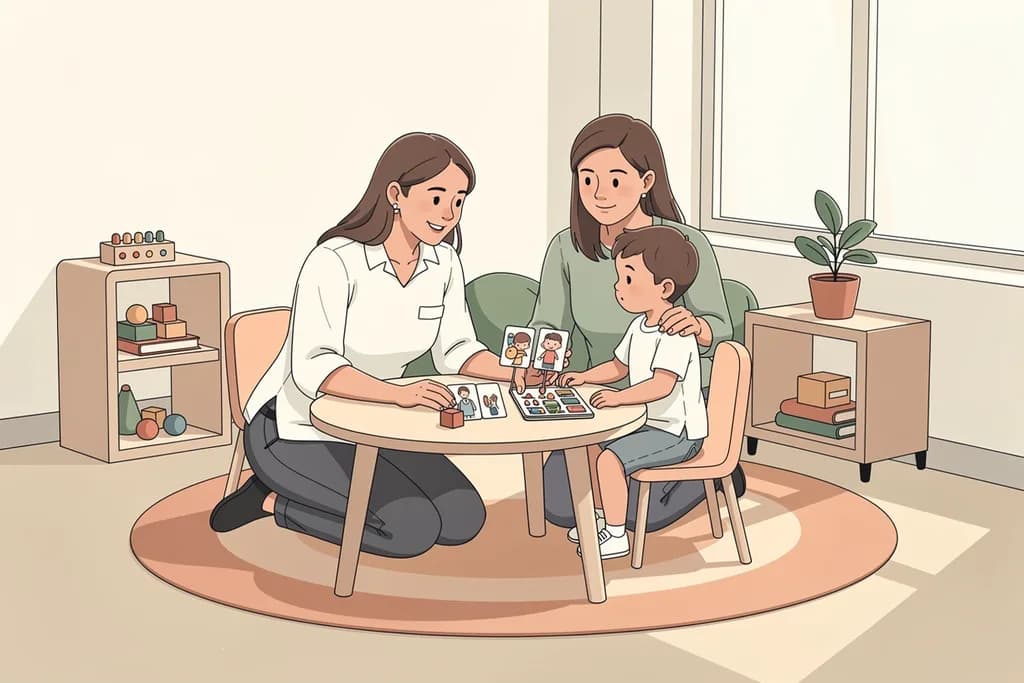
- providing information to the child in a manner suited to their age, health, developmental level and communication abilities
- using augmentative and alternative communication (AAC), pictograms, gestures or visual aids where appropriate
- considering the child’s sensory needs during visits (lighting, noise, touch)
- paying particular attention to children who, because of the nature of their disability, may have difficulty reporting harm
- working with parents and guardians to identify the best forms of communication with the child
How to report a concern
If you are a parent, guardian or child and wish to report a safeguarding concern or irregularity, you can do so:
- In person: speak to any member of staff or at reception
- By phone: call our reception number
- By email: write to the designated person (see contacts below)
Reports may be made anonymously. Every report is taken seriously and documented in accordance with internal procedures.
Persons responsible for child protection
You can contact them at any time:
| Role | Name | |
|---|---|---|
| Person responsible for child safeguarding standards | Marta Karwot-Pięta | [email protected] |
| Designated person for receiving child welfare reports | Agnieszka Orlik | [email protected] |
| Person leading interventions | Marta Karwot-Pięta | [email protected] |
| Child support coordinator | Marta Karwot-Pięta | [email protected] |
| Online safety coordinator | Grzegorz Data | [email protected] |
Data Protection Officer (DPO): Contact via reception
If the persons listed above are unavailable, their duties are assumed by a person designated by management.
Key numbers and external contacts
Key numbers — act immediately
Other support institutions:
- Family Court — Child neglect, request for a welfare review of the family
- Local Social Services Centre — Family support, neglect of a child’s needs
Staff vetting
Before being allowed to work with children, every member of staff is verified:
- we check the Sex Offenders Register
- we require a certificate of no criminal record from the National Criminal Register
- every member of staff signs a declaration confirming they have read the safeguarding standards
- every member of staff completes child safeguarding training before starting work, followed by regular refresher sessions
Personal data and image protection
Children’s personal data, including their image, are processed in accordance with the GDPR (Regulation EU 2016/679) and Polish data protection legislation:
- we process data only to the extent necessary for diagnostic and therapeutic services
- a child’s image is not recorded or published without the written consent of a parent or legal guardian
- the clinic has appointed a Data Protection Officer (DPO)
- detailed data processing rules are set out in our Privacy Policy, available at reception and on nidomed.pl
Online safety
The clinic follows rules governing the use of internet-connected devices:
- devices used in therapy (tablets, computers) are protected against access to content inappropriate for children
- the patient Wi-Fi network, where available, has content filtering enabled
- staff do not contact children through private electronic channels (social media, messaging apps)
- the online safety coordinator is Grzegorz Data ([email protected])
Review of the standards
The Child Safeguarding Standards are a living document:
- a full review of the document takes place at least every two years
- every two years we conduct surveys among staff, children and parents
- any change in the law triggers an update of the standards
- every critical incident is analysed and may lead to a change in procedures
- the results of each review are documented in writing
Healthcare provider
Registration details
- Legal name
- Nido Marta Karwot-Pięta Neurological Speech Therapy Services
- Trading name
- Nido Family Centre
- Tax ID (NIP)
- 647-218-66-53
- RPWDL number
- 000000276874
- Address
- ul. Władysława Żeleńskiego 86, 31-353 Kraków, Poland
Healthcare provider registered in the RPWDL maintained by the Voivode of Małopolska.
Approved by: Marta Karwot-Pięta, Owner